
Cost and Environmental Savings with Purpose-Built LED Temporary Lighting
It’s more and more important for construction companies to pay attention to the carbon footprint of their jobsites. After decades of wasteful practices that harm the environment, switching to purpose-built LED jobsite lights is a proactive step toward a smaller carbon footprint on construction sites.
Most people know the benefits of LED lighting: lower energy consumption, lower total cost of ownership, longer service life, and it is safer for the environment than traditional bulb-based lights. What often gets overlooked is how concentrated those savings are on a construction site, where temporary lighting typically runs 24/7 for months at a time.
The trouble with stringlights
The quick rise of LED technology has led to purpose-built jobsite lighting that can replace all the traditional bulb-based lighting typically used on jobsites. Yet temporary lighting on construction sites hasn’t changed much over the last few decades. Most projects still use the typical 50 foot or 100 foot bulb-based stringlight.
It’s well known in the industry that stringlights bring many challenges to any jobsite. They are cumbersome and time-consuming to install, they get blocked by HVAC work, they need constant upkeep, and most often they end up in a landfill after their first use. Over the years, manufacturers have kept bringing quality down to meet customer pricing demands. As a result, bulb-based lighting has become a disposable product rather than an asset, which adds waste and cost.
There is a misconception that simply replacing old bulbs with new LED bulbs is enough for contractors to reach their energy reduction goals. The intention is good, but it does not address the underlying inefficiencies, so the status quo keeps hurting project productivity, safety, costs and the environment.
Lights designed for the jobsite
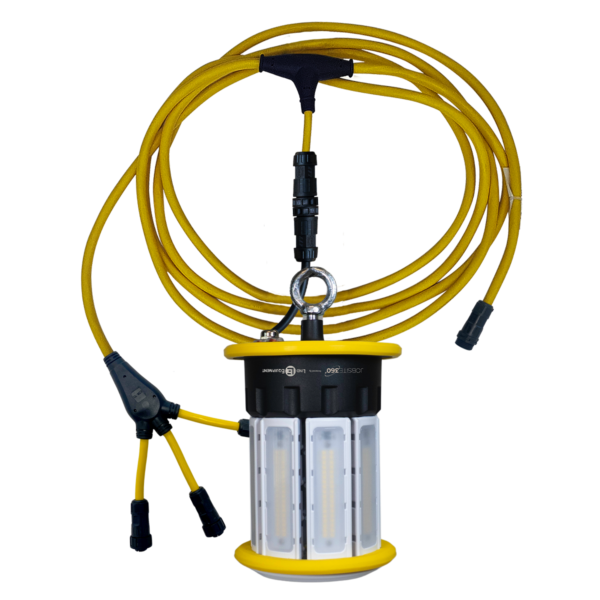
Advances in LED technology have made it possible for lighting manufacturers to design temporary lighting specifically for the construction market. The form factor of LED jobsite lights is not held back by the inefficiencies of bulb-based lights. For example, one 100-watt 360 degree LED jobsite light can illuminate 2,500 square feet, replacing 250 feet worth of stringlights to light the same size area. That cuts the installation points needed from 25 to just one, which brings labour costs down sharply along with energy consumption.
Some LED jobsite lights on the market also include a preinstalled daisy-chain cord that matches the recommended spacing for the lights. Working in ways that reduce installation and maintenance time also helps contractors deal with today’s skilled labour shortages.
Less waste, project after project
Reusing LED jobsite lights from project to project also cuts waste significantly. They contain no hazardous chemicals or toxic heavy metals, such as the mercury in compact fluorescent and metal halide bulbs. LED lights can be built to be extremely durable and weatherproof, so they stand up to water and impact on the jobsite and can be reused across multiple projects.
Over the lifetime of the single 360 degree LED light mentioned above, over 150 lbs of construction waste will be prevented. If one light can do that much, think of the impact if LED adoption scales up across the country.
A real project in Edmonton
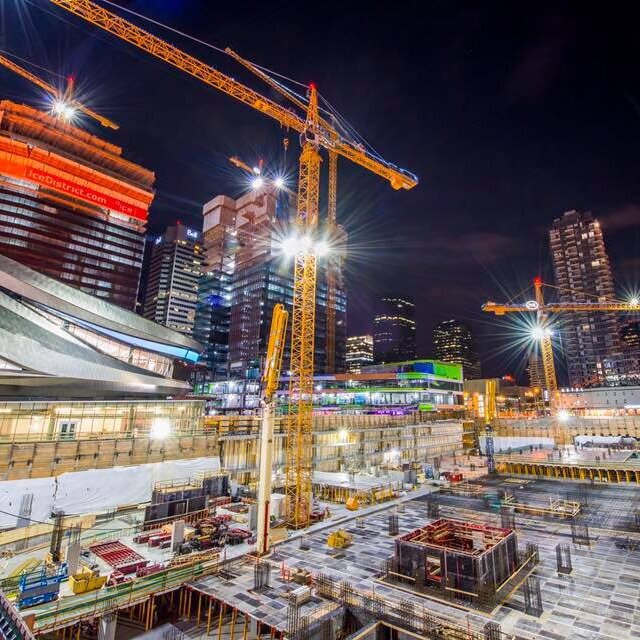
You can see the energy savings of purpose-built LED jobsite lighting on a real project: a four million square foot mixed-use sports and entertainment complex in Edmonton, Alberta.
In 2015, LED lighting in temporary applications was still a fairly new concept. Still, the decision-makers on this project saw the energy savings that LED would provide and committed to the new technology. The decision paid off. The first LED jobsite lights were deployed in early 2015. Over the next four years, LED jobsite lights were used during the construction of 5 buildings, a total of 4.2 million square feet, and cut energy consumption by 90%.
- Project electricity costs went down by $3,203,573.
- Compared to bulb-based lights, the LED jobsite lights avoided over 32,000 tonnes of CO2.
- That environmental impact is equivalent to removing 6,939 cars from the road or powering 4,847 homes per year.
Plan your next project with Jobsite360
See the savings before the project starts
Lighting simulations and projected energy consumption calculations show the estimated cost and environmental savings on a project before it begins. That makes adoption more likely, and contractors can include the benefits when they talk to their stakeholders, which gives them a competitive advantage to win more jobs.
The energy savings from switching bulb-based lighting to purpose-built LED jobsite lighting are often underestimated. Yet it can be one of the simplest sustainable changes to make, with a meaningful impact on our shared fight against climate change.
Contractors who bring high levels of safety and savings to a job, along with significant environmental benefits from efficient, reusable temporary lighting equipment, are raising the standard for sustainability across the construction industry.