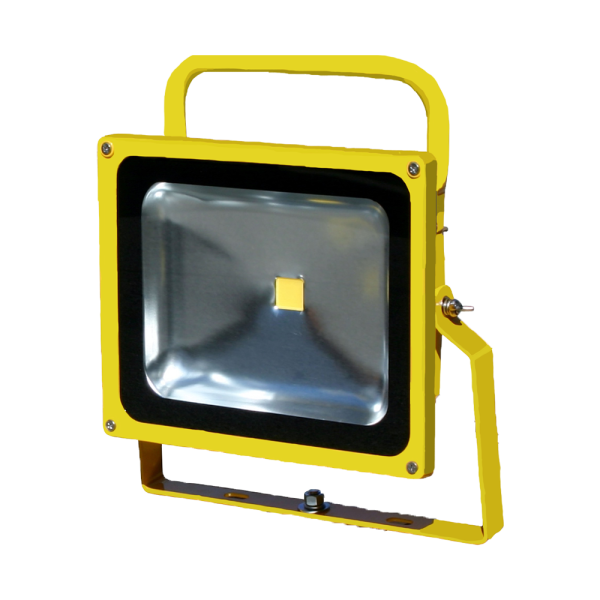

The Dangers of Quartz Halogen Work Lights
The 500W quartz halogen portable work light is everywhere. And why not? It’s cheap, easy to move and puts out a lot of light to work by. It comes in a few different styles (on a tripod, a floor stand or a magnet mount), but at its core it’s always the same: a dangerous tool that harms workers, starts fires and sets off explosions. Everywhere we go at Lind Equipment, we hear the same complaint: quartz halogen lights are too hot, and people are getting hurt.
What the infrared camera showed
A look at the data shows why everyone is complaining. We measured a 500W quartz halogen portable work light with an infrared camera for more than four hours. Within the first hour, the light had already reached its maximum temperature of over 300°C (more than 570°F). That temperature will ignite paper and wood. It is the melting point of pewter. Styrofoam turns liquid at this temperature. And that’s before we even talk about what it would do to human skin.
Below is an infrared picture of the 500W quartz halogen light after one hour. The colours show the different temperature levels in the picture. The number in the upper right corner is the maximum temperature in the picture: here, 329°C, the hottest point on the light. The number in the middle right is the temperature at the point where the crosshairs sit: 314°C, near the middle of the light.
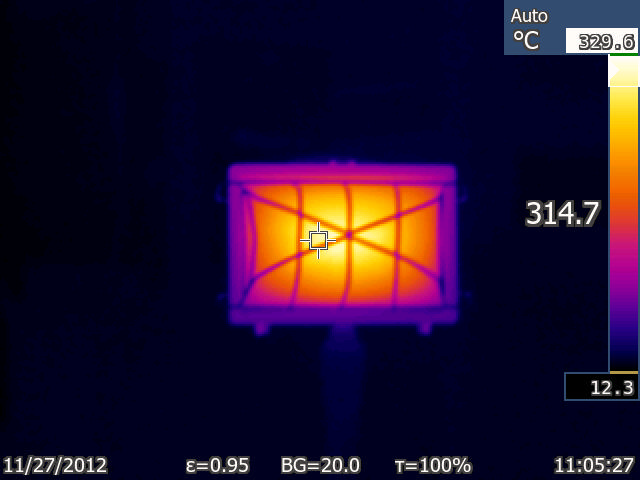
Think about touching it with your hand, or any other part of your body, and the real danger of a heat source like this becomes clear. Skin burns at about 100°C (212°F), which means the 500W quartz halogen light is an immediate danger just by being in the same room. When we looked closely at the infrared images, we found that even the guard meant to protect the user from the hottest part of the light reached more than 100°C (212°F). With the crosshairs centred on one of the guard wires, the reading in the middle right of the screen showed 106°C. So once a quartz halogen light has been powered up for any reasonable length of time, there is no safe spot to touch it.
A fire hazard, too
A light that gets this hot is also a fire hazard. Many types of flammables, including common gasoline, ignite at lower temperatures than a quartz halogen light can reach.
One of our customers told us about a quartz halogen light left out overnight that burned through the wood planks of a scaffold. In the morning, they found the light burning through its second set of planks, a full storey below where it was left the night before. Stories like this aren’t uncommon, and that customer was simply lucky the light didn’t start a bigger fire. Another customer told us about a quartz halogen light wrapped in a fire blanket: the light was so hot that the fire blanket began to smoulder and smoke.
Why crews still use them
So why do workers keep using a light that is clearly dangerous? Sadly, until now they rarely had another choice. As mentioned above, the 500W quartz halogen light gives off a lot of light and is small and portable. Those advantages made it popular, and prices dropped so far that it ended up everywhere. Everyone knew these lights were dangerous, but put up with it, because nothing else gave off that much light in such a small, portable unit.
Now there are other technologies on the market that are getting a lot of attention. LED technology has developed to the point where a work light can give off the same usable light as a 500W quartz halogen, with none of the downside risks.
LED and quartz halogen, side by side
Most people know the basics of LEDs by now. They never need bulb changes, they’re much more energy efficient than other lighting technologies, and they run cool. That last benefit tends to be overplayed, as LEDs can generate heat. But even with a moderate amount of heat sink design, an LED light comes nowhere close to the heat of a 500W quartz halogen light.
Once again, the data makes the case. We ran a 500W quartz halogen work light side by side with Lind Equipment’s Beacon Light, a 50W LED portable floodlight. The Beacon Light gives off the same amount of usable light in the same flood pattern, which makes it an excellent unit for an apples-to-apples comparison. We left both lights running and took periodic infrared readings to compare their operating temperatures.
Note: the Beacon Light in this test is an earlier Lind model and is not in our current catalogue. For a current LED floodlight, see the Beacon970 Floodlight.
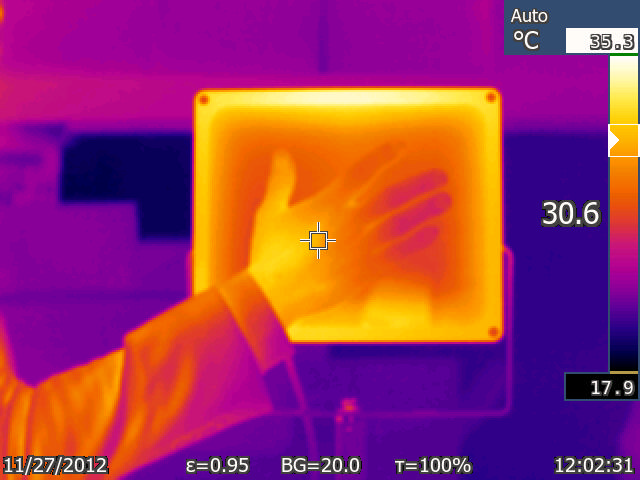
Like the quartz halogen light in our first test, the LED floodlight reached its maximum temperature in under an hour. Unlike the quartz halogen light, it kept operating in a temperature range that was not dangerous and could not start a fire. The LED floodlight’s maximum temperature was just about 35°C (95°F). For comparison, the temperature reading of a human hand is just below 31°C (89°F), so the LED floodlight was only slightly warmer than a firm handshake. In the image below, you can see the maximum temperature in the upper right (35.3°C) and the temperature of the hand at the crosshairs in the middle right (30.6°C).
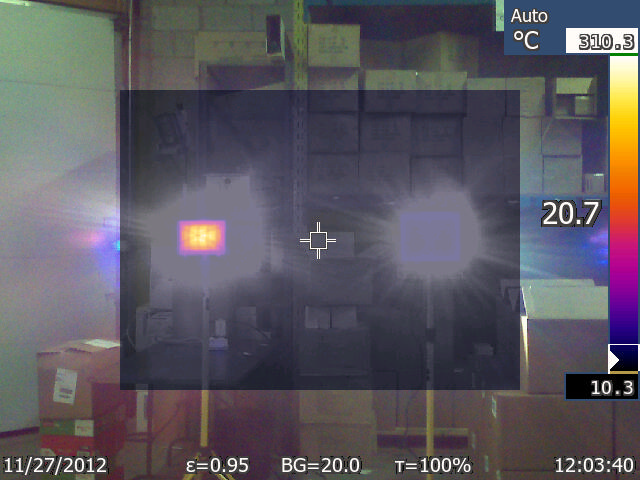
Shown together in a composite visual and infrared image, the LED floodlight’s infrared signature almost disappears next to the extreme heat of the quartz halogen light on the left.
A safer choice on the job
A portable LED floodlight that gives the same usable light as a quartz halogen, uses less energy (50W vs. 500W), never needs a bulb change (50,000-hour life) and runs at almost 1/10th of the heat level (35°C vs. 300°C) will save lives and reduce injuries in the workplace. Now that workers finally have a choice of a bright, portable work light, we hope they’ll stay away from lights that send them home with serious burns.
Many thanks to Fluke and Westburne for the use of the infrared camera.